
The State of Our Reefs: Why Phu Quoc’s Coral Needs Us Now

The ocean around Phu Quoc is struggling. We all know it. But looking at the actual data makes it hit differently. Back in 2016, a massive bleaching event ripped through these waters. The average bleached coral ratio hit 28.2 percent here. That was severely worse than other areas along the coast. And it hasn't really stopped.
Coastal Region (2016) | Bleaching Ratio |
Phu Quoc Coast | 28.2% |
Ninh Hai Coast | 5.6% |
Con Dao Islands | 3.8% |
The 30-Day Blueprint: Building a Sanctuary on the Sea Wall
Researchers have tracked a steady, painful decline. Reefs are shrinking by about 0.72 percent every single year. Then the recent global heatwave came through. It cooked up to 90 percent of the coral cover in spots like the Coral Jungle Reef. We have to do something real.
So we are building an ex-situ coral nursery right here. This nursery is part of a larger 0.03 ha development in Phu Quoc supported by MPA authorities.
We gave ourselves exactly 30 days to build the physical structure. It is going to be a massive push. We are building 8 separate growth units. Each tank is exactly 42 inches by 24 inches. That is 106.68 cm by 60.96 cm if you are using metric. It sounds weirdly specific because it is. We measured our own arm spans for this. You have to be able to reach the dead center of the tank without crushing a fragile fragment on the edge. You need to be able to clean every inch of the glass.


We found the perfect spot to put them. We are putting heavy frames right along the rock sea wall on the beach. At low tide the sandy seabed is completely exposed. You can walk right up to where the frames will sit in the dry sand. Week one is just going to be hauling heavy materials down to this sand. We have to
anchor the frames deep into the seabed before the tide comes back in. It is messy, heavy work.
But high tide changes the whole environment. The ocean comes up a few feet around the base of the structures. It naturally cools the tanks down. We engineered the height so the water level stays safely below the rim.
We don't want wild waves crashing in and sweeping our rescued corals away during a storm.

We are not just filling glass boxes with water. We are setting up a tidal flow-through system. We will plumb intake lines straight out into the ocean. The pumps will pull fresh, ambient seawater in during the natural tide shifts. They will flush the old water out. The corals will still get real ocean nutrients. They will still feel the natural tidal rhythm. But they stay completely protected from the extreme thermal spikes and sediment that are baking the open reefs right now.


Saltwater is brutal on hardware. Everything has to be sealed perfectly. So the last two weeks of our 30-day build are purely for testing and cycling the water. You can't just throw sensitive coral into a brand new tank. The biological filters have to stabilize. We have to watch the flow rates. We will be out there every single day checking the parameters.
Completing this 30-day structural phase is just the beginning; it sets the stage for a critical 6-month biological recovery plan.
Month | Activity / Milestone |
MONTH 1 | DAY 1-14: Frame anchoring & sea wall plumbing DAY 15-30: Water cycling & tidal pump calibration |
MONTH 2 | Pioneer soft coral introduction (Sarcophyton & Sinularia) |
MONTH 3 | Hard coral rescue intake (Acropora, Pavona, Diploastrea) |
MONTHS 4-6 | Biological monitoring, feeding & fragment stabilization |
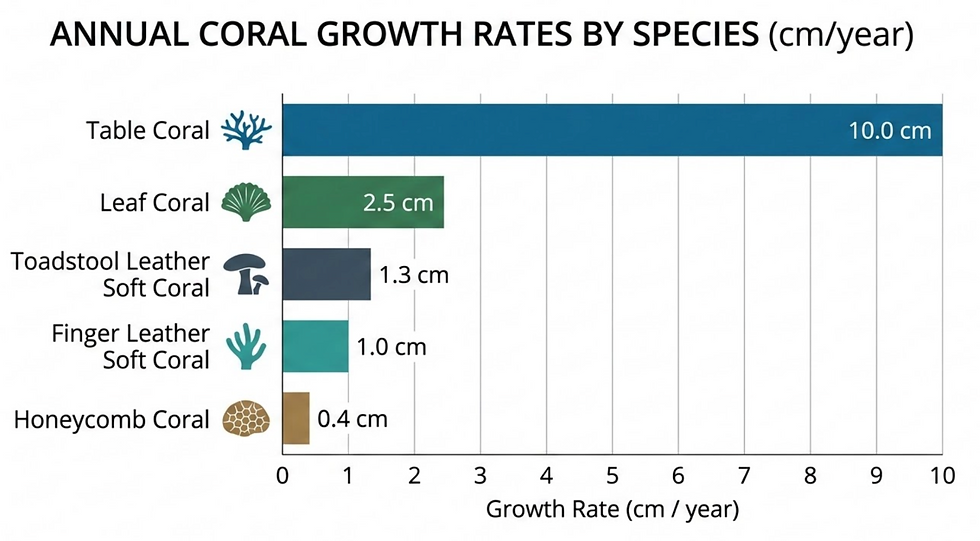
We have a very specific plan for what goes into those 8 tanks. We are focusing on five very different species to make this work. And understanding how fast they actually grow changes everything about how you manage a nursery.
People think all coral grows at the same speed. It doesn't. Some species sprint while others barely move a millimeter a year.
We need species that can survive and grow fast. That is why we are dedicating our first nursery units to pioneer soft corals.
Toadstool Leather Coral (Sarcophyton glaucum)
This native soft coral looks like a thick, rubbery mushroom. In the wild it grows around 1.0 to 1.3 centimeters per year radially. But in a controlled nursery with stable flow, it heals from fragmentation fast. It doesn't build a hard calcium skeleton. It uses fleshy tissue instead. That makes it tough. It handles intertidal shifts without complaining and helps get our biological filtration settled.
Finger Leather Coral (Sinularia polydactyla)
Another hardy Phu Quoc native. It extends finger-like branches around 0.5 to 1.0 centimeters a year. Why grow it? Because baby fish and reef invertebrates love hiding in it. Getting Finger Leather established in our tanks creates instant micro-habitats. It builds up our nursery biomass right away.
But we are mostly going after the hard corals that are dying out there. The ones getting hit hardest by the heat.
Table Coral (Acropora hyacinthus)
This is our sprinter. Acropora hyacinthus grows fast for a hard coral. Healthy colonies can push out branches at roughly 10 centimeters per year. It forms those giant, beautiful plates that shade the reef. But it is super sensitive to hot water. When heatwaves hit Phu Quoc, Acropora is usually the first to bleach and die. By nursing rescued fragments in our tidal tanks for five months, we can protect them during the hottest weeks before replanting them.
Leaf Coral (Pavona decussata)
Listed as Vulnerable on the IUCN Red List. It grows thick, cactus-like upright fronds at a moderate pace of roughly 1.5 to 3.0 centimeters per year. What makes Pavona special is how adaptable it is. It can handle murky water and shading better than branching corals. But coastal runoff here has been burying it. Cleaning off smothered fragments and moving them into our 42 by 24 inch units lets them recover their natural color and tissue.
Honeycomb Coral (Diploastrea heliopora)
This one breaks your heart. Diploastrea is an ancient, massive brain-like reef builder. It is ridiculously slow. It only grows between 2 and 6 millimeters per year. That is less than half a centimeter. A colony the size of a coffee table can be hundreds of years old. When a heatwave kills a Diploastrea head, you aren't just losing a coral. You are losing centuries of history. In our nursery, we aren't trying to grow massive new heads of Honeycomb Coral in five months. We are saving damaged, centuries-old pieces from dying completely.
Our ex-situ efforts are a direct response to the escalating thermal stress in local waters. Recent monitoring has shown a concerning trend in the average bleaching ratios within the nursery area. In 2020, the bleaching ratio was recorded at 20%, which unfortunately increased to 21% in 2021. These figures underscore the necessity of our controlled environment to mitigate the impact of rising sea temperatures on vulnerable species.
Inside the Nursery: Our Species-Specific Strategy
Strategic Growth: Managing a Diverse Coral Community
Rigorous Guardianship: Daily Maintenance & Monitoring
Maintaining a stable environment within our 8 growth units requires rigorous daily oversight. Our monitoring protocol focuses on water chemistry and system mechanics to ensure the best possible recovery conditions for the rescued fragments.
Water Quality Testing: We conduct daily tests for nitrate and phosphate concentrations, as well as monitoring nitrite and ammonia levels. Maintaining low nutrient levels is critical, as excessive concentrations can lead to harmful algae growth.
Flow Rate Monitoring: We constantly observe the tidal flow-through system's rates. Proper calibration of the pumps is essential to ensure a consistent supply of fresh, nutrient-rich seawater while avoiding physical damage to the corals from excessive turbulence.
Biological Filter Health: The stabilization of biological filters is a primary focus, especially during the initial cycling phase. We monitor the microbial communities that help process waste and maintain the chemical balance required for sensitive species like Acropora and Diploastrea.
Getting them out of the stressful ocean gives them a fighting chance. We will feed them. We will monitor them. They get five months of perfect, protected conditions to heal and grow. Let's get to work on these frames.
Phase 2 Implementation: Maintenance & Monitoring Schedule
Following the 30-day construction phase, we will initiate a rigorous 5-month maintenance and monitoring protocol to ensure the survival and growth of the rescued coral fragments.
Task Category | Action Items |
Water Chemistry | Daily testing for Nitrate (<0.1 mg/L) and Phosphate (<0.01 mg/L) to prevent algae blooms. |
System Health | Calibration of tidal pumps and cleaning of growth unit glass to ensure maximum light penetration. |
Biological Monitoring | Weekly assessment of fragment health, looking for signs of disease, bleaching, or tissue recovery. |
By maintaining these parameters, we provide a stable "living gene bank" for sensitive genotypes like Acropora hyacinthus and the slow-growing Diploastrea heliopora.


great start to the project